
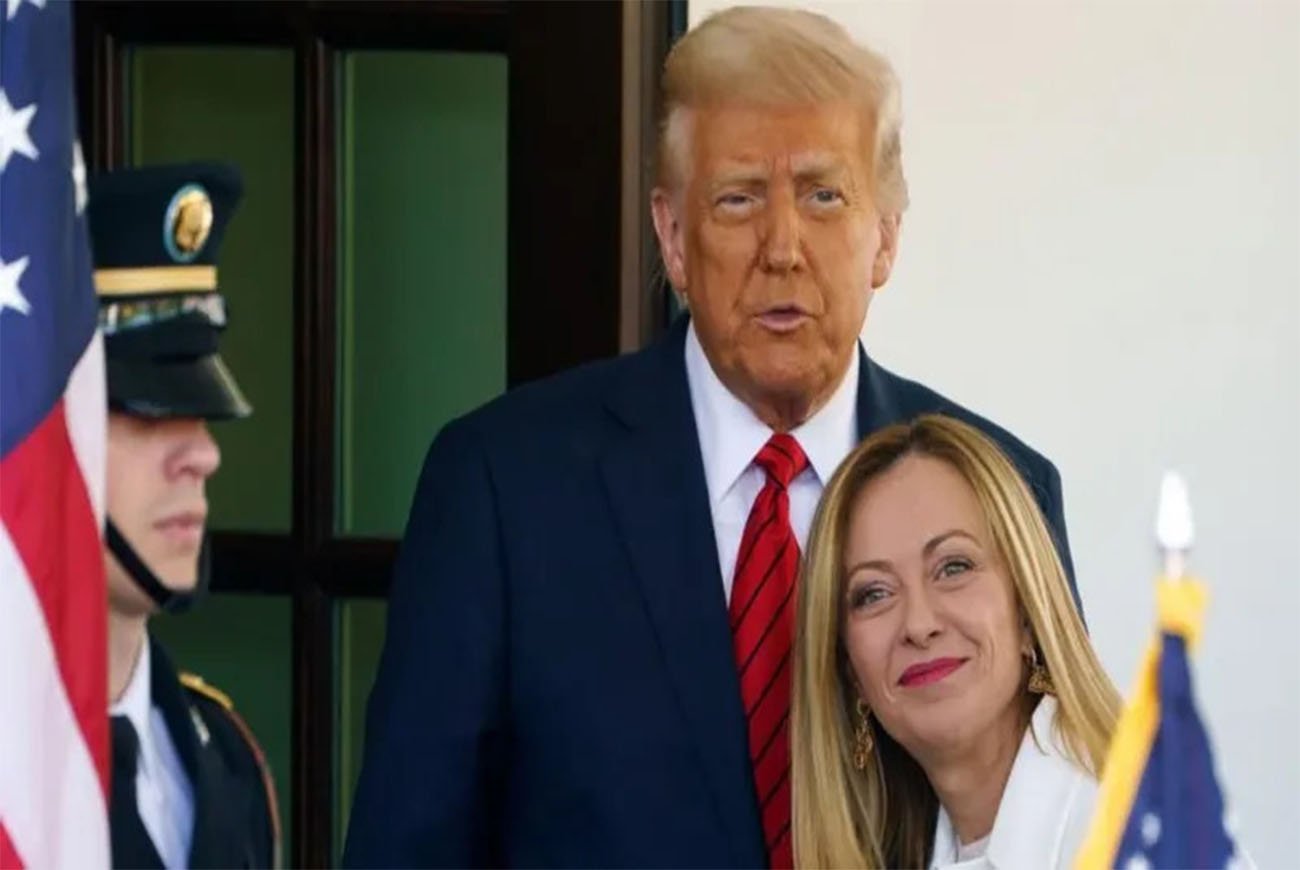
There is an AI-generated meme doing the rounds on social media in Italy that shows Giorgia Meloni doing all the things you might expect from someone fresh out of a tough break-up.
In one fake photo, she has a new, sharper haircut—shorter, more defiant, as if she is reclaiming her independence. In others, she is imagined booking herself on a singles’ holiday to some exotic destination, training obsessively for a marathon to clear her head, or cautiously creating a profile on a dating app, unsure whether to swipe right on a new political ally or an old adversary.
None of the images are real, of course. But the joke has landed with remarkable precision because it captures something genuine: the very public, painfully messy political fallout between the Italian prime minister and US President Donald Trump.
Over the past few months, their relationship has lurched from public attacks to personal insults and back again, cooling what was once one of the most closely watched and strategically significant alliances in European politics. What began as a partnership of convenience—a meeting of two right-wing populists who recognised each other’s political instincts—has curdled into something far more toxic, leaving diplomats on both sides of the Atlantic scrambling to contain the damage.
1. From ‘Trump whisperer’ to political orphan
It was not that long ago that Meloni was being hailed in Washington and Brussels alike as the “Trump whisperer”—the one European leader who could navigate the mercurial American president’s moods, translate his impulses into policy, and perhaps even moderate his more extreme positions.
She was the only European leader with a front-row seat at his January 2025 inauguration, a highly symbolic gesture that cemented her status as Trump’s preferred partner in Europe. Photographs of the two smiling together, shaking hands in the Capitol’s rotunda, were splashed across Italian newspapers with headlines celebrating a new era of transatlantic friendship.
Last April, she was also the EU leader of choice to head to the White House for a meeting aimed at easing tensions over US tariffs on European goods. That visit was seen as a diplomatic triumph: Meloni emerged from the Oval Office looking composed and confident, and for a brief moment, it seemed she had managed to do what no other European leader could—secure a hearing, if not a concession, from a president notoriously hostile to multilateral trade agreements.
For someone who started on the fringes of Italian politics—with roots in the country’s post-fascist tradition, a background that once made her a pariah in mainstream European circles—and who has spent years trying to rebrand herself as a moderate, credible, and statesmanlike face of the European right, that closeness to Trump was never seen merely as a useful diplomatic tie.
To observers, it was proof, on the biggest stage available, that she belonged there. It validated her long and painstaking transformation from a firebrand opposition politician to a serious international leader. It silenced her domestic critics, who had long dismissed her as too extreme to govern. And it gave her a unique selling point among her European counterparts: she had the ear of the most powerful man in the world.
But that asset has increasingly become a liability.
Trump’s unpredictability—his impulsiveness, his thin skin, his tendency to view diplomacy as a zero-sum game of personal loyalty—has proved extraordinarily difficult for Meloni to handle. Each new slight, each fresh insult, has dented her credibility both nationally and internationally. The woman who once boasted of her special relationship with Washington now finds herself defending Italy’s dignity against the very man she once courted.
2. The first cracks: Bases, bombs, and the Pope
The first real fracture in the relationship came in late March, and it was rooted not in personal animosity but in a concrete policy disagreement with profound constitutional implications.
Italy’s defence ministry refused to allow US military aircraft bound for the Middle East to use the Nato airbase at Sigonella in Sicily without prior parliamentary approval. The decision was not arbitrary—it was rooted in Italy’s constitution, which requires parliamentary authorisation for military operations involving foreign powers, and it reflected the Italian public’s deep and enduring opposition to the war in the region.
For Trump, however, the refusal was a betrayal. In his view, allies were expected to support US military operations without question, and Italy’s hesitation was seen as a sign of weakness or, worse, disloyalty. Behind closed doors, US officials reportedly expressed frustration at what they characterised as Italian obstructionism, though publicly they maintained a diplomatic silence.
Weeks later, the row deepened in a way that no one could have predicted.
Trump attacked Pope Leo XIV on Truth Social in April over the pontiff’s criticism of the war, calling him “weak on crime” and suggesting that the Pope should focus on the internal affairs of the Catholic Church rather than meddling in geopolitics. The attack was extraordinary—not just because it targeted a globally revered religious figure, but because it came at a time when Trump was already struggling to maintain alliances with traditionally friendly nations.
Meloni, governing a deeply Catholic country where the Pope’s word carries enormous moral and political weight, called the attack “unacceptable.” Her response was measured but firm, and it signalled a clear departure from her previous reluctance to criticise Trump publicly.
Trump did not take it well.
“I’m shocked at her,” he told Italian daily Corriere della Sera in an interview that sent shockwaves through Rome’s political establishment. “I thought she had courage, but I was wrong.” He added, with characteristic bluntness: “She is unacceptable… she is not the same person, Italy is not the same country.”
The remark was widely interpreted in Italy as a personal rebuke not just of Meloni but of the nation itself—a suggestion that Italy had somehow changed for the worse under her leadership. It was the kind of comment that would have been unthinkable between traditional allies, and it marked a turning point in the relationship.
3. The G7 summit: A brief thaw, then humiliation
By June, however, there were signs that the relationship might be on the mend. At the G7 summit in Évian-les-Bains, France, Trump and Meloni were photographed deep in conversation on a sofa, their body language suggesting a degree of comfort and familiarity that had been conspicuously absent in recent months. Italian officials spoke hopefully of a “clarifying discussion” that had cleared the air.
Meloni told reporters that the atmosphere had been “very positive,” with “no friction.” She smiled for the cameras, struck a confident pose alongside her fellow leaders, and appeared to have weathered the storm. For a moment, it seemed that the diplomatic machinery had done its work, smoothing over the rough edges of a relationship that had become dangerously frayed.
But journalists barely had time to file their stories before it all fell apart again.
Days later, Trump gave a phone interview to Italian broadcaster La7—an interview that was dubbed into Italian and never aired in its original English. In it, he offered a startlingly different account of the G7 encounter, one that painted Meloni not as a valued ally but as a supplicant.
“She wanted a picture with me so badly,” Trump’s Italian voiceover said, his words delivered in a flat, almost dismissive tone. “I wouldn’t have taken it, but I felt sorry for her.”
The implication was clear: Meloni had begged for a photo opportunity that Trump had reluctantly granted out of pity. It was a humiliating portrayal, and it reduced a complex diplomatic relationship to a crude power dynamic in which Meloni was cast as the desperate supplicant and Trump as the magnanimous benefactor.
Meloni did not wait long to respond. Within hours, she posted a video on social media, delivered directly to camera in Italian, her expression steely and her voice unwavering. She called Trump’s account “completely fabricated.”
“I don’t know why the president of the United States behaves this way toward his own allies,” she said, her words carefully chosen to underscore the betrayal. “I can only say it’s a pity he doesn’t show the same resolve toward the enemies of the West… But there’s one thing he must remember: neither I nor Italy ever beg.”
The video went viral almost immediately, resonating not just in Italy but across Europe, where many leaders had grown weary of Trump’s abrasive style. It was a rare moment of public defiance from a leader who had built her reputation on loyalty to allies, and it struck a chord with Italians who felt their national pride had been wounded.
4. Domestic backlash and a deepening crisis
The fallout in Italy was swift, overwhelming, and entirely across the political spectrum—a rare moment of national unity in a country known for its fractious politics.
Italy’s foreign minister, Antonio Tajani, cancelled a planned trip to Washington, a highly unusual diplomatic snub that underscored the severity of the crisis. Tajani, a seasoned diplomat with close ties to the US, described Trump’s remarks as “offensive” and said they had made his visit “impossible” under the current circumstances.
Italian President Sergio Mattarella, the country’s largely ceremonial head of state, phoned Meloni personally to express his solidarity—a gesture that carried significant symbolic weight, as Mattarella is known for his careful political neutrality. His call was widely interpreted as a signal that the presidency stood behind the prime minister in the face of foreign humiliation.
Meloni’s government colleagues and MPs from across her coalition called the remarks offensive, damaging to Italy’s dignity, and deserving of an apology. Some went further, suggesting that Italy should reconsider its role in US-led military operations if such treatment continued. Opposition members, meanwhile, condemned the comments as an unacceptable affront to the country as a whole, accusing Trump of treating Italy with contempt.
Even Italian media, which is often deeply divided along political lines, was united in its condemnation. Editorials in both left-leaning and right-leaning newspapers described Trump’s behaviour as boorish and unbecoming of a head of state. Political commentators noted that the episode had exposed the fragility of Italy’s reliance on the US relationship—a reliance that had been a cornerstone of Italian foreign policy since the Second World War.
Trump, however, was not done.
From Camp David, he doubled down. On Truth Social, he insisted that Meloni had asked “over and over” for the photo, and he accused her of trying to be “friends again” now that the US had “defeated Iran militarily.” The implication was that Meloni was opportunistic, seeking to mend fences only after the military outcome had been decided—a charge that infuriated her allies in Rome.
Just as that dispute seemed to be cooling, a separate row re-opened over military bases, with Italian officials again insisting on parliamentary oversight of US military flights. The issue, which had never been fully resolved, threatened to reignite the entire conflict, leaving diplomats on both sides wondering whether the relationship could ever return to its former warmth.
Conclusion: A relationship beyond repair?
As the dust settles on the latest round of recriminations, the question on everyone’s mind is whether the Meloni-Trump relationship can be salvaged.
Some observers argue that the partnership was always transactional—a meeting of convenience between two political outsiders who saw mutual benefit in cooperation. If that is the case, then the current crisis may simply be a bump in the road, a temporary disruption that can be smoothed over with the right combination of diplomatic gestures and policy concessions.
Others are less optimistic. They point to the deeply personal nature of the insults—the mockery, the belittling, the suggestion that Meloni had “begged” for a photo—and argue that such wounds do not heal easily. Trust, once broken, is notoriously difficult to rebuild, and Trump’s unpredictability makes any long-term planning almost impossible.
For Meloni, the stakes are extraordinarily high. Her political credibility, both at home and abroad, rests in part on her ability to manage Italy’s relationship with Washington. If she is seen as weak or ineffective in that role, her domestic opponents will not hesitate to exploit the perception. At the same time, a complete rupture with the US would be politically and economically disastrous for Italy, which relies on American military support and trade ties.
For now, Meloni is playing a delicate balancing act: defending Italy’s dignity without provoking a complete break. Whether that strategy will succeed—or whether the relationship will continue its downward spiral—remains to be seen.
What is clear, however, is that the era of the “Trump whisperer” is over. The woman who once boasted of her access to the Oval Office now finds herself defending her country’s honour against the man she once called a friend. And in the cold, unforgiving world of international politics, that is a fall from grace that may prove impossible to reverse.








One Comment
Lorem ipsum dolor sit amet, consectetur adipisicing elit. Minima incidunt voluptates nemo, dolor optio quia architecto quis delectus perspiciatis. Nobis atque id hic neque possimus voluptatum voluptatibus tenetur, perspiciatis consequuntur.