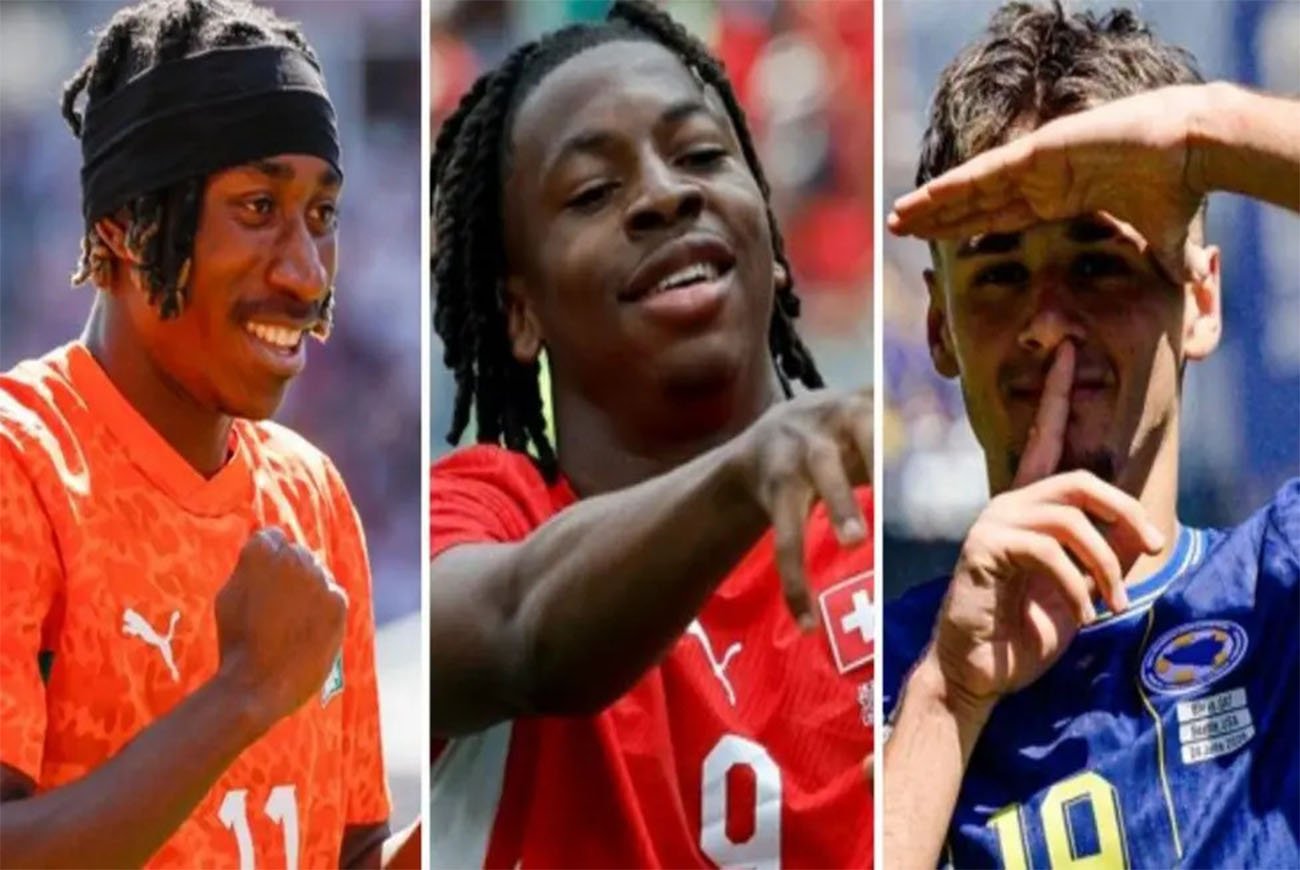
It’s not just World Cup veterans Lionel Messi and Cristiano Ronaldo who have made their mark at the 2026 tournament – the next generation is also making a huge impression. While the two legends continue to defy age and expectations, a wave of young talent is emerging, ready to take the mantle and write their own chapters in football history.
Of the 85 players aged 21 or under selected to feature in the United States, Mexico and Canada, many have seized the moment and are playing without fear. The tournament has become a showcase for the future of the sport, with teenagers and young adults demonstrating that they belong on the biggest stage.
Senegal’s Ibrahim Mbaye, aged 18 years and 143 days, became the fourth youngest goalscorer in World Cup history when he scored a late consolation for the Lions of Teranga in a 3-1 defeat by France in New Jersey on 16 June. His goal was a moment of individual brilliance, a reminder that age is no barrier to making an impact.
Five days later, Lamine Yamal (18 years and 343 days) popped up with Spain’s first in a 4-0 victory over Saudi Arabia in Atlanta. The Barcelona prodigy has been one of the tournament’s standout performers, justifying the hype that has surrounded him for years.
Other youngsters have flown under the radar. Mexico’s teenage attacking midfielder Gilberto Mora was not even born when Messi, Ronaldo and Luka Modric played at the 2006 World Cup. Mora became the youngest player to represent a home nation at the World Cup (17 years and 240 days) when he came on as a substitute in a 2-0 win over South Africa, the very first game of this tournament on 11 June.
We already knew Lamine Yamal would be a key player at the World Cup. But who are the young breakout stars to emerge from the group stage? BBC Sport looks at five who have caught the eye.
Ayyoub Bouaddi (Morocco, aged 18)
On his World Cup debut against Brazil on 13 June, Lille midfielder Ayyoub Bouaddi became the second youngest player this century to record 50-plus passes in a World Cup game (66) during an eye-catching display. His composure on the ball and tactical intelligence were remarkable for a player of his age.
Former England captain Alan Shearer, working at the Brazil game for BBC Sport, was impressed. “Bouaddi was composed on the ball and tried to dictate things in the middle of the park,” he said.
The teenager later became the first player aged 18 or under to have two games since 1966 with 50-plus passes (64 v Scotland). His performances have been a revelation, and he has established himself as a key figure in Morocco’s midfield.
Bouaddi’s rise has been rapid. He only made his senior debut for Lille last season, but his performances in Ligue 1 earned him a call-up to the national team. At the World Cup, he has shown that he belongs at the highest level.
His ability to read the game, distribute the ball, and break up opposition attacks has drawn comparisons to some of the game’s great midfielders. At just 18, he has a bright future ahead of him.
Yan Diomande (Ivory Coast, aged 19)
Paris St-Germain are interested in Yan Diomande. So too are Liverpool. And it’s not hard to see why when you study this master-dribbler at this World Cup.
The RB Leipzig teenager created five chances in the 1-0 win over Ecuador before registering two key passes in a 2-1 defeat by Germany. His ability to beat defenders and create opportunities for his teammates has made him one of the tournament’s most exciting players.
“Diomande is the talk of the town for everyone at the moment,” former Tottenham and Brentford boss Thomas Frank told BBC Sport. “What he can do is stored in the hard disk in my head.”
Ivory Coast failed to get out of the group stage in their previous three World Cup appearances. Diomande is one of the reasons why they have reached the knockout stages for the first time. His performances have been instrumental to their success.
Diomande’s dribbling ability is exceptional. He glides past defenders with ease, using his low centre of gravity and quick feet to create space. His vision and passing range are also impressive, making him a complete attacking midfielder.
At 19, he is already one of the most sought-after young players in world football. The interest from Europe’s elite clubs is a testament to his quality.
Johan Manzambi (Switzerland, aged 20)
Johan Manzambi was once a goalkeeper for his youth team – and his first footballing idol was Germany’s Manuel Neuer. Now he’s a creative midfielder who enjoys going forward – and scoring goals.
Three of Switzerland’s seven group stage goals came from Manzambi, who at the age of 20 years and 247 days, became the youngest player in World Cup history to score two goals or more in a game as a substitute – and the first ever player to do so for Switzerland at the tournament.
That happened against Bosnia-Herzegovina on 18 June. It was 0-0 when he came on in the 71st minute, with the Swiss running out 4-1 winners. His impact was immediate and decisive.
Manzambi is also one of only three players aged under 21 with four or more goal involvements (three goals and one assist) at a World Cup tournament this century, after Kylian Mbappe in 2018 (4) and Thomas Muller in 2010 (8).
His versatility and attacking instincts have made him a valuable asset for Switzerland. He can play as a winger, an attacking midfielder, or even as a second striker. His ability to find space and finish chances has been crucial to Switzerland’s success.
Kerim Alajbegovic (Bosnia-Herzegovina, 18)
Aged 18 years and 276 days old, Kerim Alajbegovic became the youngest player on record (since 1966) to score a World Cup goal from outside the box – surpassing Kylian Mbappe against Croatia in 2018 (aged 19 years and 207 days) – when his stunning strike gave Bosnia-Herzegovina the lead against Qatar on 24 June.
The youngster, who turned out for Red Bull Salzburg last season, appeared in all three of Bosnia-Herzegovina’s group games – starting two – as they progressed to the knockout stage, and will face co-hosts the United States in California on 1 July.
In the 3-1 win over Qatar, Alajbegovic contested the most duels (17), won the most duels (10), completed the most dribbles (6), won the most fouls (4) and created the joint-most chances (2) of any player for either team. His all-round performance was exceptional.
Alajbegovic’s goal against Qatar was a moment of magic. He picked up the ball 25 yards from goal, drove forward, and unleashed a powerful strike that flew into the top corner. It was a goal worthy of winning any match.
His performances at the World Cup have put him on the radar of several top European clubs. At 18, he has the potential to become one of the best players of his generation.
Nestory Irankunda (Australia, 20)
Nestory Irankunda (20 years and 125 days) became the youngest player to score a goal for Australia at the World Cup when he got the first in a 2-0 win over Turkey.
He is just the fourth player to score a goal on his World Cup debut for Australia after John Aloisi, Tim Cahill and Craig Goodwin.
“It is unreal and a dream come true,” said Irankunda, born in a Tanzanian refugee camp in 2006 to Burundian parents who had fled their homeland because of a civil war. His story is one of resilience and determination.
Watford fans know all about Irankunda, who scored four times for the Hornets in the Championship in 2025-26. He joined them from Bayern Munich in 2025 to play more first-team football.
Irankunda’s pace and directness have made him a handful for defenders. He is not afraid to take on opponents and create chances for himself and his teammates. His goal against Turkey was a classic striker’s finish, a testament to his composure in front of goal.
His journey from a refugee camp to the World Cup is an inspiring one. It is a reminder of the power of sport to transform lives and create opportunities.
The future is bright
The performances of these young players at the World Cup are a sign of the changing of the guard in international football. While Messi, Ronaldo, and other veterans continue to excel, the next generation is ready to take over.
The tournament has provided a platform for these youngsters to showcase their talents on the biggest stage. They have seized the opportunity with both hands, playing with freedom, confidence, and flair.
The future of football is in good hands. The next generation is here, and they are ready to shine.