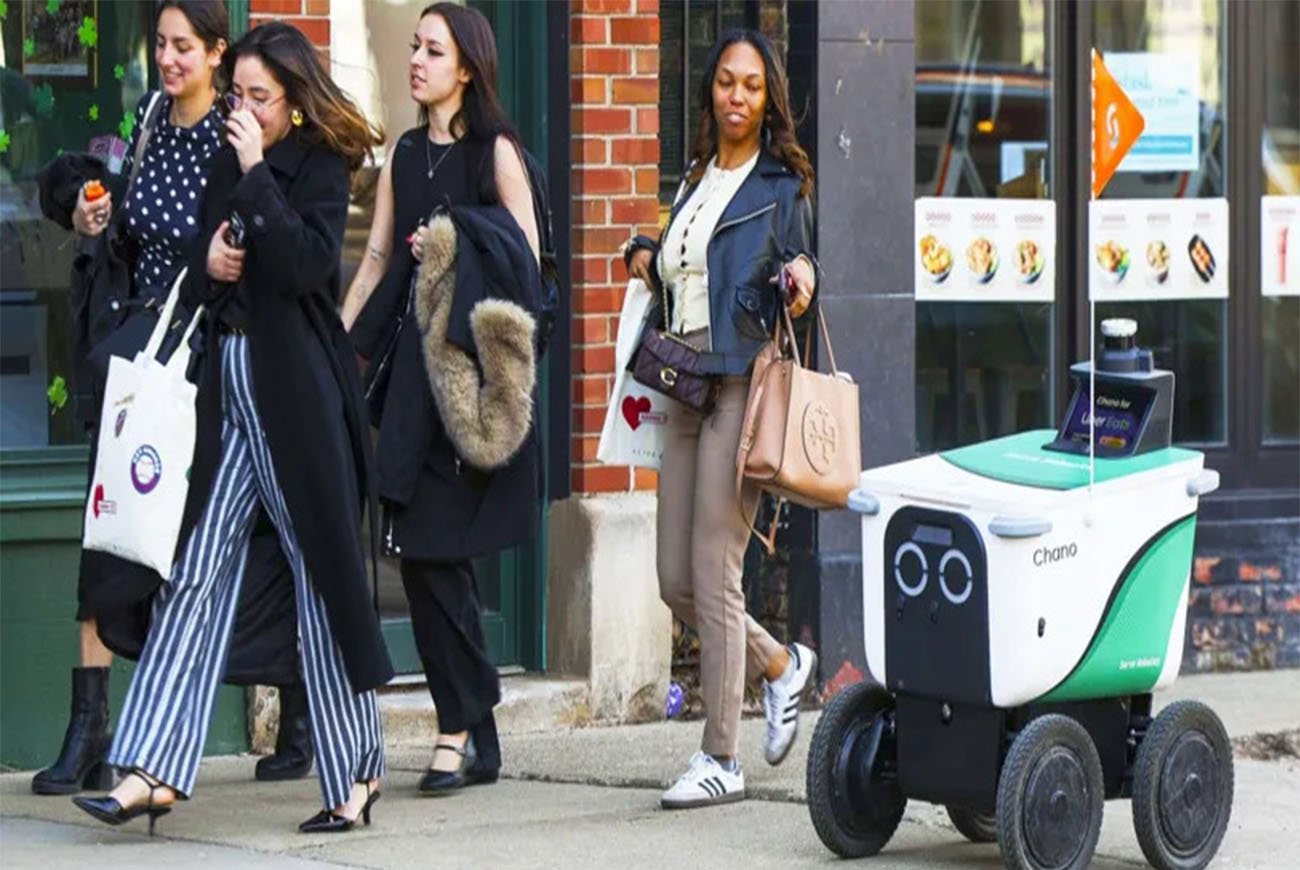
The first time Chicago resident Josh Robertson saw a delivery robot trundling down the sidewalk on his street he was impressed. The small, boxy machine moved with quiet determination, its sensors blinking as it navigated around obstacles and continued on its way. It was a glimpse of a future that had once seemed confined to science fiction.
“I actually thought they were kind of neat – it felt futuristic,” he says.
But his attitude started to change when, soon after, he was out for a walk with his family. As another robot approached, they found themselves having to dodge it. The machine did not slow down, did not acknowledge their presence, and did not yield. They were the ones who had to step aside.
“To us it felt a little off – the fact that we were on the one strip reserved for walking, and we were having to get out of the way,” says Robertson. “I started thinking about what it would be like for us to go for a walk as a family if there were dozens of robots with lights and cameras zipping around.”
His concerns are not isolated. Across the United States, and in several other countries around the world, a quiet battle is being fought over who—or what—has the right to use public pavements. The robots, more formally known as autonomous urban delivery vehicles, have started to appear on sidewalks in a number of cities across the US, plus in the UK, Japan, South Korea and Germany, transporting groceries and fast food, using cameras, sensors and GPS to navigate.
According to the companies operating them, they can reliably identify and avoid objects in the path, cross streets safely and react to their environment. The robots provide a useful service and help cut down on traffic and emissions, they claim. But for many pedestrians, the experience of sharing their walkways with these machines has been far from seamless.
The human cost of automation
It is easy to see the appeal of delivery robots from a commercial perspective. They are cheap to operate, they do not require breaks, they do not call in sick, and they can work around the clock. For companies like Starship Technologies, which operates in several countries, the robots represent the next logical step in the evolution of last-mile delivery.
However, some local authorities in the US and Canada, and members of the public, are less than enthusiastic. Bans have been put in place, and protests have been launched. The tension between technological progress and public space has become a flashpoint in cities where these machines have appeared without warning or consultation.
San Francisco has limited the access of the vehicles to less busy parts of the city, and Toronto has since 2021 prohibited the robots from using sidewalks entirely. Meanwhile, in Chicago the machines have now been banned from two small areas of the city. These are not blanket bans, but they are significant first steps in pushing back against what some see as an invasion of public space.
Robertson wants the robots to be suspended across all of Chicago until safety tests are carried out, and clear rules are set on their usage. He has launched a petition calling for this, and so far, it has around 4,400 signatures. The number is growing, reflecting a broader unease among residents who feel that their concerns are being ignored.
People frequently find themselves having to step into the street in order to get out of the machines’ way, says Robertson. For elderly residents, parents with young children, and people with disabilities, this is not just an inconvenience—it is a genuine safety risk.
“There have been reports of collisions and injuries. I saw one a few days ago where somebody had been struck by one of the robots’ safety flags, which is a little ironic,” he says. “We’ve got reports of robots causing issues with traffic, blocking emergency vehicles because they’re acting erratically at crosswalks.”
His concerns are borne out by anecdotal evidence from other cities. In some cases, robots have been observed freezing in the middle of crosswalks, creating hazards for drivers. In others, they have failed to detect obstacles and have collided with pedestrians or cyclists. While the companies insist these incidents are rare, they have eroded public trust.
A regulatory vacuum
Similar concerns have emerged in Glendale, California, where the local council is considering a temporary ban on the use of the vehicles. Councillors say the robots appeared without warning, and at first they didn’t even know which company was supplying them. The lack of transparency has fuelled suspicion and frustration.
“What triggered the concern and the discussion was a number of factors,” says Coun Ardy Kassakhian. “The increased visibility of the robots in the downtown, and the question about accessibility and pedestrian movement on our public sidewalks.
“Plus, uncertainty regarding the regulatory authority – because no-one asked us for permission to use the sidewalks for this business enterprise – and then the broader concern was about the impact on workers and public places.”
Sidewalks in Glendale aren’t particularly wide, adds Kassakhian, and he personally has witnessed a “stand-off” between a delivery robot and an elderly person, as well as broken-down robots causing obstructions. These are not hypothetical concerns; they are real-world problems that have emerged in the absence of clear rules.
Kassakhian says the council is seeking a regulated approach for the longer term. “We need a regulatory framework, we need to designate operating rules, insurance requirements, accessibility standards, possibly permitting fees, operational limits in high pedestrian areas, and to have accountability for the operators.”
The situation in Glendale is emblematic of a broader challenge facing cities around the world. The technology is advancing faster than the laws designed to govern it, leaving local authorities scrambling to catch up. In the absence of clear regulations, companies have been free to deploy their robots with minimal oversight.
Vandalism and resistance
In the UK, where delivery robots are being piloted in a number of cities, some locals have taken matters into their own hands. There have been reports of Uber Eats vehicles being vandalised in Sheffield. The machines have been tipped over, kicked, and in some cases, set on fire. The resistance has been fierce and immediate.
The supplier of these machines, Starship Technologies, says they are perfectly safe and that perceptions need to change. The company has been operating in the UK since 2018 and has conducted trials in several towns and cities.
“We know it’s a new experience for a lot of people to share a pavement with a robot,” says the company’s European operations director Danny Pass. “But the robots are friendly, they’re polite and they’re programmed to be careful. They’ve slotted into everyday life in loads of communities since we started out in the UK back in 2018.”
But the company’s assurances have not been enough to quell public unease. In some communities, the robots have become symbols of unwanted change—a sign that corporate interests are being prioritised over the needs of ordinary people.
Not all concerns, though, are centred around pedestrian safety. The Independent Workers Union of Great Britain (IWGB), whose members include delivery drivers, is worried about the impact on jobs. It says it is keeping a watchful eye, and it has already expressed its concerns to the government.
“I think if it became more of a [permanent, countrywide] reality, we’d definitely have to be thinking about where we put on pressure – whether that’s government, TfL [Transport for London], or local authorities – to ensure that these things are banned, because the human impact would be massive,” says president Alex Marshall.
“This would mean whole communities in London, where a lot of people are precarious workers, would really suffer. People would be fighting for their lives against these pointless robots.”
The union’s concerns are not unfounded. The delivery sector has become a major source of employment for gig economy workers, many of whom are already struggling with low pay and insecure conditions. The introduction of autonomous delivery robots threatens to displace thousands of workers, with little in the way of a safety net.
The promise of regulation
While the use of autonomous delivery robots is still limited, analysts believe they’re set for a major boom. A report last summer from research firm Transforma Insight concluded that by 2034, there will be 2.1 million in operation around the world. The scale of the projected growth is staggering, and it has prompted calls for urgent regulatory action.
Currently, there’s a hotchpotch of regulation worldwide. Some countries, such as South Korea and Japan, have taken a liberal approach, welcoming the robots as a symbol of technological progress. Others, like the US and Canada, are more cautious, with local authorities taking the lead in setting rules.
In Europe, the situation is similarly fragmented. Some cities have embraced the robots, while others have imposed restrictions or bans. The lack of consistency has created uncertainty for both companies and the public.
There is a growing consensus among experts that clear, consistent regulations are needed to ensure the safe and equitable deployment of delivery robots. These regulations should address issues such as safety standards, insurance requirements, and the protection of pedestrian rights. They should also consider the impact on workers and the potential for job displacement.
A broader question about the future
Back in Chicago, Robertson says he is fighting for the best possible outcome for pedestrians city-wide. His campaign has drawn attention to the broader question of who public spaces belong to, and who gets to decide how they are used.
“There’s a sense that change like this, even when it’s unwanted, is inevitable. But even if none of us can stop the future, we can at least choose which future we move into.”
His words capture a sentiment shared by many who find themselves on the front lines of technological disruption. The robots are coming, but that does not mean we have to accept them without question. We have the power to shape the future, to set the rules, and to ensure that technology serves us rather than the other way around.
The debate over delivery robots is not just about machines on pavements. It is about the kind of society we want to build, and whether we are willing to let convenience and profit override the needs of human beings. It is a debate that will define our relationship with technology for generations to come.
A lesson from history
There are parallels between the current backlash over delivery robots and the historical resistance to other forms of automation. When cars first appeared on city streets, they were met with suspicion and hostility. Pedestrians resented sharing their space with noisy, dangerous machines, and there were calls for bans. Over time, regulations were put in place, and cars became an accepted part of urban life.
The same pattern is likely to unfold with delivery robots. The technology is here to stay, but its integration into our cities will require careful thought and deliberate action. We cannot simply let companies dictate the terms; we must demand a seat at the table.
The decisions we make today will shape the cities of tomorrow. Will we allow robots to dominate our pavements, or will we insist on a balanced approach that prioritises the needs of people? The answer will depend on how effectively we organise, advocate, and hold decision-makers accountable.